← All work
01Consumer · B2C·2026·Streaming · Content Discovery

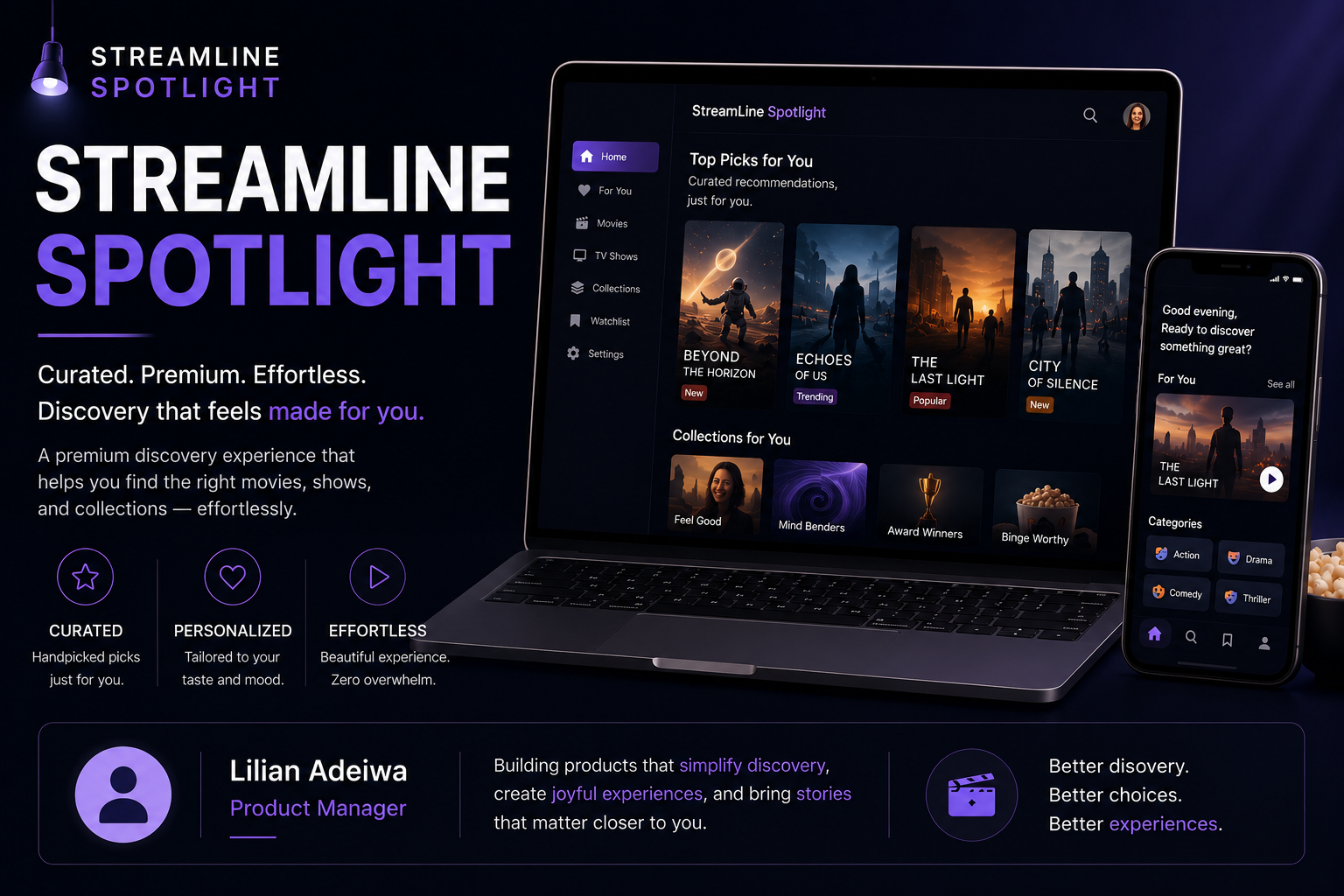
StreamLine Spotlight

Curing decision fatigue with human-curated discovery.

Project snapshot

Product
Consumer streaming — discovery feature
Role
Product Manager · Discovery → Roadmap
User
Overwhelmed viewers browsing without a clear intent
Problem
More content was creating more friction, not better discovery.
Scope
Discovery through validation plan (2026)
Target
Target: 30+ minute sessions from 11% baseline to 15%, DAU decline ≤2%

01 · The problem

More content was creating more friction, not better discovery.

StreamLine had built a large content library, but overwhelmed viewers were struggling to decide what to watch. Instead of trusting the platform to help them, users were browsing endlessly, leaving to search for recommendations elsewhere, and returning only after they had already decided. The challenge was not content availability — it was discovery confidence.

  1. 01Browse endlessly
  2. 02Feel overwhelmed
  3. 03Leave StreamLine
  4. 04Search elsewhere
  5. 05Decide externally
  6. 06Return to watch
SignalWhat it revealed
Endless browsingContent abundance was contributing to decision fatigue
External discoveryUsers were leaving StreamLine to make discovery decisions elsewhere
Low discovery trustMore recommendations did not necessarily create more confidence
Slow time-to-choiceUsers needed clarity and trusted guidance, not more content rows

02 · What I learned

The real competitor was not another streaming service. It was the entire discovery journey outside StreamLine.

The competitive and workaround analysis showed users were relying on external review platforms, video platforms, social content, search engines, and curated services to decide what was worth watching. StreamLine was still winning playback, but losing the decision-making moment.

  1. Inside StreamLine

    Browse → Overwhelm → Uncertainty

  2. Outside StreamLine

    Search → Compare → Build confidence → Decide

  3. Back to StreamLine

    Return → Press Play

The opportunity was not to add more recommendations. It was to make discovery feel calmer, faster, and more trustworthy.

High-level journey map

Browse → Discover → Decide → Watch. The break sits at Decide.

03 · The product decision

I chose curation over more complexity.

I prioritized a focused Spotlight experience built around mood-based entry points and a curated content rail. The decision was deliberately narrow: reduce cognitive overload, help viewers find meaningful options faster, and build trust through intentional curation.

MVP decisionPurpose
Mood-based entry pointHelp users begin discovery from intent rather than endless browsing
Curated Spotlight RailReduce choice overload with a focused selection
"Why You'll Love This" contextGive users confidence before pressing play
Lightweight discovery flowReduce time and effort between opening the platform and watching

04 · What I built

A calmer path from browsing to watching.

Spotlight replaces open-ended browsing with an intentional discovery flow — a smaller set of curated recommendations with context that helps viewers choose faster.

  1. Browse

    User enters StreamLine but faces content overload.

  2. Discover

    User enters Spotlight and selects a mood or discovery direction.

  3. Decide

    User explores curated recommendations with clear context.

  4. Watch

    User chooses faster and begins meaningful viewing.

05 · Validation

I designed the experiment to test behaviour, not just preference.

The experiment was designed to test whether a human-curated Spotlight rail could increase meaningful viewing among the target audience without harming overall platform health.

MeasureExperiment definition
Primary metric30+ minute viewing sessions
Baseline11%
Target15%
Minimum detectable lift+4 percentage points
GuardrailOverall DAU decline must not exceed 2%
Test window2–4 weeks
DecisionShip, Iterate, or Kill based on observed results

Reflection

Concentrating the roadmap on one bet made the evaluation credible. What I'd validate next: whether the signal generated by curation actually improves a future personalization layer — or whether trust in human editors becomes the product on its own.