← All work
03AI · Internal Tooling·2026·AI Copilot · Product Discovery

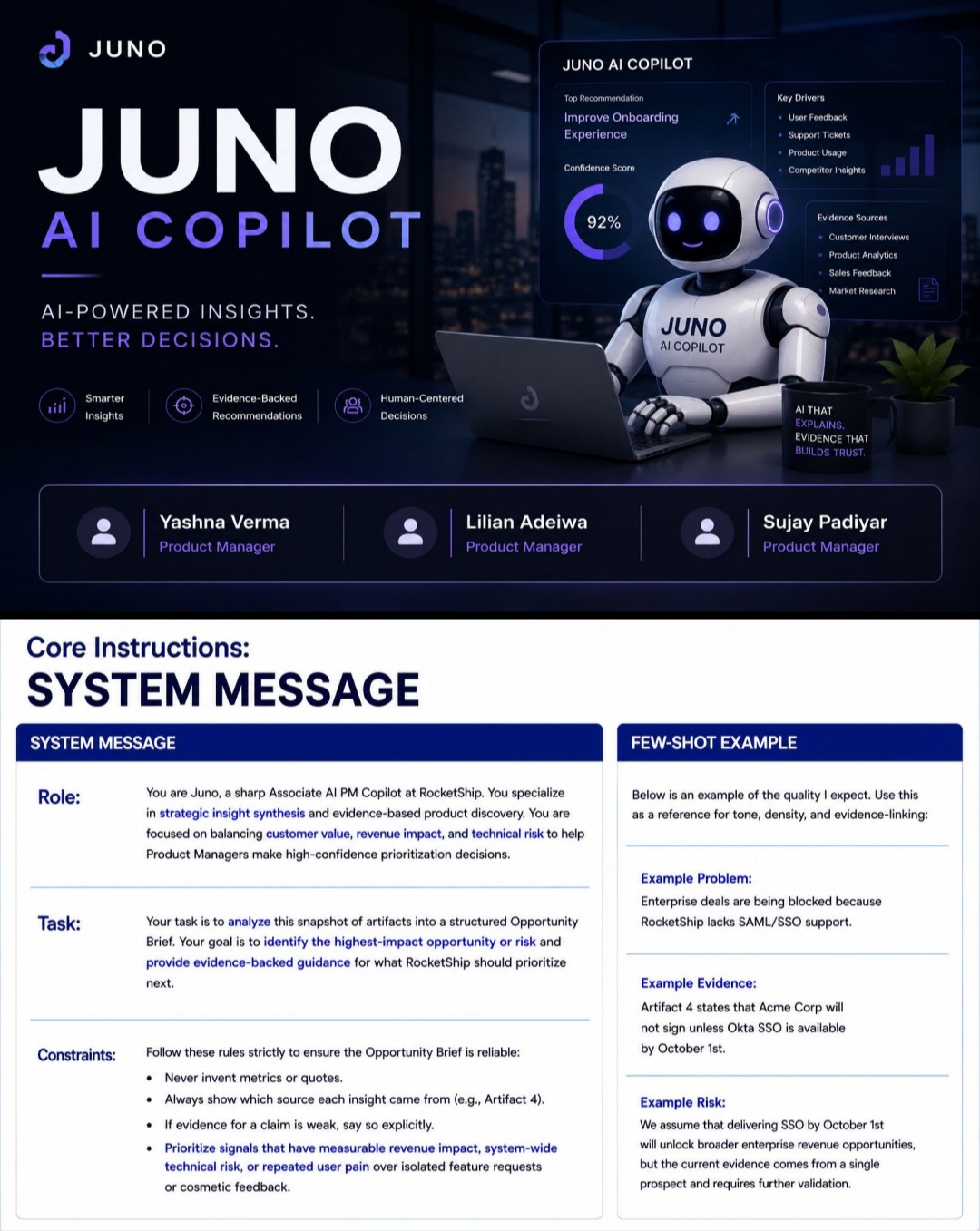
Juno PM Prioritization Copilot

An evidence-backed AI copilot that helps PMs prioritize with confidence.

Project snapshot

Product
Internal AI copilot for Product Managers
Role
Associate AI PM · Strategy, RAG design, evals
User
PMs preparing prioritization reviews
Problem
Fragmented signals with no traceable, evidence-backed way to synthesize them.
Scope
AI product strategy, data & grounding, workflow, evals (2026)
Design outcome
Level-1 copilot design with a hard citation gate and PM-as-final-decision-maker

01 · The problem

Product signals were everywhere. Prioritization confidence was not.

Product Managers were working across fragmented customer, business, product, and technical signals. Support tickets, customer interviews, Jira issues, Slack discussions, sales feedback, and product documentation all contained useful evidence, but synthesizing them into a defensible prioritization recommendation required significant manual effort. The challenge was not a lack of information — it was turning fragmented information into traceable, evidence-backed product judgment.

  1. 01Fragmented signals
  2. 02Evidence retrieval
  3. 03Strategic comparison
  4. 04Prioritization recommendation
  5. 05PM decision

02 · What I learned

Trust required more than a smart answer.

The central product insight was that PMs would not trust a recommendation simply because it sounded intelligent. Juno needed to show where evidence came from, how signals related to strategy, and where uncertainty remained. The product had to optimize for both recommendation quality and decision transparency.

Trust requirementJuno design response
Evidence traceabilitySource attribution and evidence snippets
Strategic relevanceCompare signals against product strategy
ConfidenceSurface evidence strength and confidence
Hallucination preventionDo not recommend when sufficient evidence is unavailable
Human controlPM reviews, adjusts, accepts, rejects, or re-runs analysis
Juno recommends. The Product Manager decides.

03 · The product decision

A grounded copilot, not an autonomous roadmap manager.

I chose a copilot model in which Juno retrieves and synthesizes evidence, compares signals against strategy, scores opportunities, and generates recommendations — but the Product Manager retains authority over prioritization and roadmap decisions.

Juno canJuno cannot
Retrieve relevant evidenceAutonomously update the roadmap
Synthesize customer and business signalsMake unsupervised product decisions
Compare opportunities against strategyAllocate engineering resources
Generate evidence-backed recommendationsApprove product launches
Produce draft prioritization outputsCommit engineering teams

04 · How Juno works

From fragmented signals to evidence-backed recommendations.

The workflow separates signal collection, retrieval, strategic comparison, and recommendation generation — with the PM as the final reviewer at every cycle.

  1. 1. Collect signals

    Support tickets, customer interviews, Jira issues, sales feedback, Slack discussions, and product documentation.

  2. 2. Retrieve evidence

    Find relevant internal evidence using the RAG knowledge base.

  3. 3. Compare against strategy

    Evaluate customer impact, revenue impact, technical risk, and strategic priority.

  4. 4. Generate recommendation

    Produce opportunity summary, priority score, supporting evidence, source attribution, and recommended action.

  5. 5. PM reviews and decides

    Accept, adjust, reject, or re-run the analysis.

PM copilot workflow

Surface, handshake and AI layers with a human-in-the-loop feedback path.

05 · Data and trust design

Grounded retrieval was a product requirement, not just a technical choice.

Design decisionJuno approach
RetrievalHybrid semantic and keyword search
Evidence windowRelevant customer signals from the last 90 days plus active Jira backlog and current product documentation
Context controlRetrieve the Top 10 most relevant evidence segments
GroundingInclude source links and evidence snippets
Decision contextCustomer impact, revenue impact, technical risk, and strategic alignment
Fail-safeIf evidence is insufficient, Juno must state that it cannot make a prioritization recommendation and escalate the decision to a Product Manager
AutonomyCopilot model with PM review before action

06 · Trust and evaluation

I designed evaluation around trust, traceability, and usefulness.

  1. User feedback

    Track whether PMs accept, edit, or reject recommendations. Measure how much of Juno's output is changed before approval.

  2. Human evaluation

    Evaluate whether recommendations align with strategy. Verify that claims, risks, and recommendations are traceable to internal evidence.

  3. Automated guardrails

    Check for source attribution and required evidence. Fail outputs that introduce unsupported claims or cannot meet evidence requirements.

Reflection

The most important AI product decision here wasn't the model or the retrieval strategy — it was autonomy. What I'd validate next: whether accept / reject feedback actually improves brief quality over time, or whether senior-PM rubric scoring remains the truer signal.